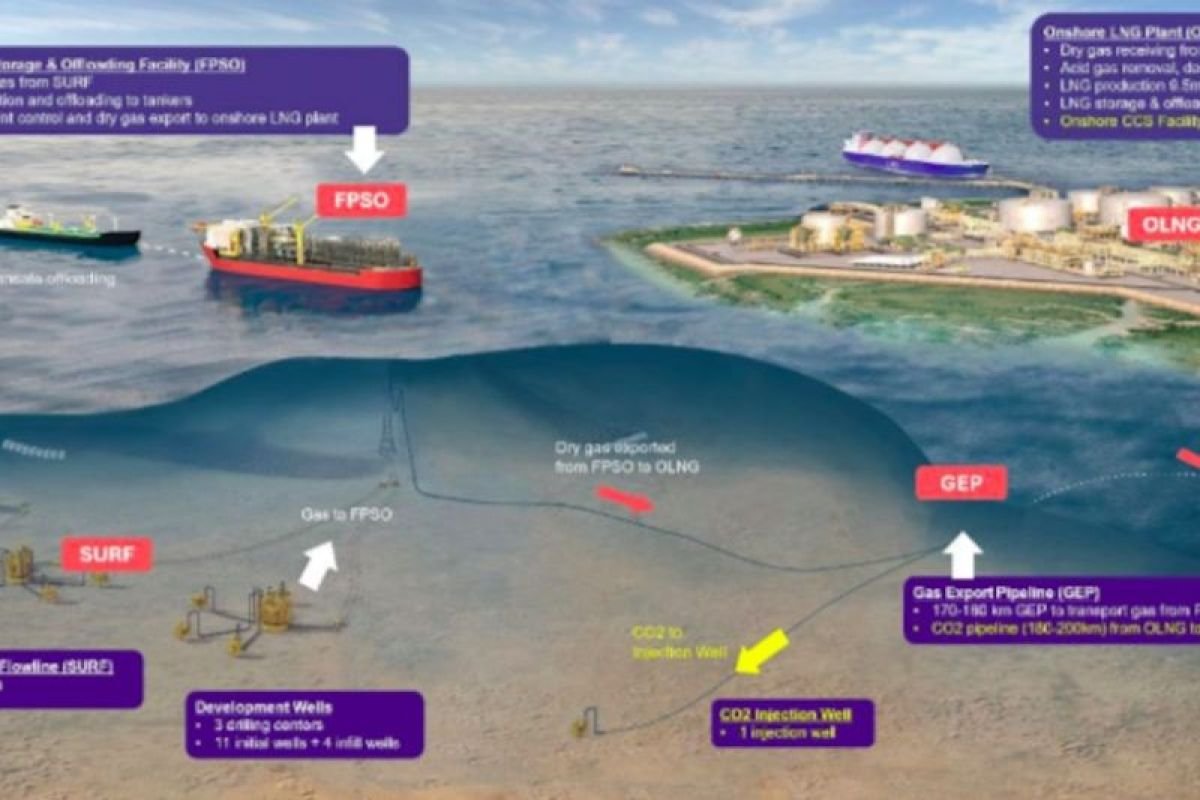
Indonesia has officially commenced construction of the long-delayed Abadi Masela liquefied natural gas (LNG) project in the Masela Block, marking a significant milestone in the nation's pursuit of energy security and self-sufficiency. This strategic development, after nearly three decades of deliberations, is set to bolster domestic gas supply and reduce reliance on volatile global energy markets.
The groundbreaking of the Abadi Masela project is a pivotal moment for Indonesia's energy landscape, signaling a firm commitment to leveraging its vast natural gas reserves to meet burgeoning domestic demand and insulate its economy from geopolitical energy shocks. The project's integrated carbon capture and storage (CCS) technology also positions it as a key player in the country's energy transition, balancing fossil fuel production with environmental objectives.
Executive Summary
President Prabowo Subianto virtually inaugurated the Abadi Masela LNG project on July 16, 2026, culminating 28 years of debate primarily over onshore versus offshore development. The project, located in the Tanimbar Islands District of Maluku, now features a consortium led by INPEX Masela Ltd. (65%), with Pertamina Hulu Energi Masela holding 20% and Petronas Masela 15% after Shell's 2023 withdrawal. With front-end engineering design (FEED) at 79.56% completion, the final investment decision (FID) is anticipated by year-end, promising 9.5 million metric tons of LNG annually and 150 million standard cubic feet per day for domestic pipelines.
What Happened
On July 16, 2026, Indonesia officially began the construction phase of the Abadi Masela LNG project, with President Prabowo Subianto virtually breaking ground. This followed decades of delays since the initial contract in 1998, primarily due to disagreements over development methods. The project's consortium saw a significant change in 2023 when Pertamina and Petronas acquired shares from Shell.
Key Developments
- Decades of Delay Ended: The Abadi Masela project's construction commenced 28 years after its initial contract, overcoming prolonged debates on development strategy.
- Pertamina's Strategic Role: Pertamina Hulu Energi Masela holds a 20% stake in the project, stepping in after Shell's exit to strengthen national participation.
- Integrated CCS Technology: Abadi Masela is designed with carbon capture and storage (CCS) technology from the outset, aligning with Indonesia's energy transition goals.
Regional Context
The Abadi Masela project is one of five national strategic upstream oil and gas projects, collectively valued at approximately US$45.82 billion, aimed at preventing Indonesia from falling into a fiscal-energy trap. Its development also comes amid heightened global energy market instability, including disruptions in the Strait of Hormuz earlier in 2026.
Market Impact
The project's anticipated annual output of 9.5 million metric tons of LNG and 150 MMSCFD for domestic pipelines will significantly reduce Indonesia's reliance on imported energy, thereby stabilizing the national budget and insulating it from global price fluctuations. This increased domestic supply is expected to provide long-term energy security for traders, refiners, and analysts monitoring Southeast Asian markets.
Outlook
With the final investment decision expected by year-end and FEED nearing completion, the Abadi Masela project is on track to become a cornerstone of Indonesia's energy future. Its successful implementation will be closely watched as a model for balancing fossil fuel development with carbon reduction technologies in the region.