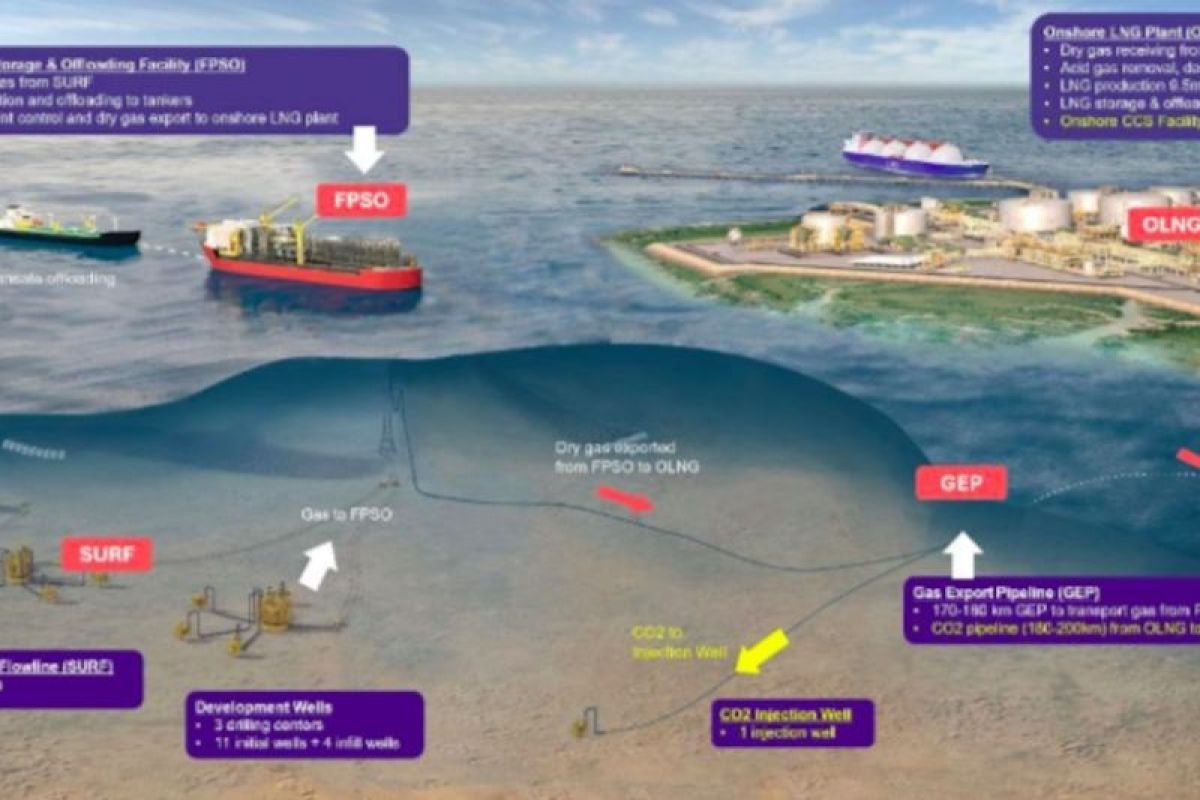
Indonesia has officially commenced construction of the long-delayed Abadi Masela liquefied natural gas (LNG) project in the Tanimbar Islands District, Maluku, a strategic national initiative valued at nearly $21 billion aimed at bolstering the nation's energy security. This groundbreaking ceremony, led by President Prabowo Subianto, marks a pivotal moment after decades of bureaucratic hurdles and consortium changes.
The Masela project is critical for Indonesia's energy future, poised to significantly increase national LNG production and reduce reliance on imports, particularly as existing gas fields decline. Its development underscores a renewed commitment to leveraging domestic resources for economic growth and energy independence.
Executive Summary
After 28 years of deliberations, Indonesia has finally broken ground on the Abadi Masela LNG project in the Tanimbar Islands District, Maluku, with an estimated investment of nearly $21 billion. This strategic project, with Pertamina Hulu Energi Masela holding a 20% stake alongside INPEX and Petronas, is designed to produce 9.5 million metric tons of LNG annually and supply 150 million standard cubic feet of pipeline gas daily to the domestic market. The initiative is expected to contribute up to $137.7 billion to Indonesia's GDP by 2055 and is Indonesia's first LNG development to integrate carbon capture and storage technology from the outset.
What Happened
President Prabowo Subianto virtually launched the construction of the Abadi Masela LNG project on July 16, 2026, from Merdeka Palace, with Energy and Mineral Resources Minister Bahlil Lahadalia leading an onsite ceremony in Tanimbar. This event followed decades of delays since the contract was signed in 1998, with the project undergoing several consortium changes, including Pertamina taking over shares alongside Petronas after Shell's withdrawal in 2023. Front-end engineering design (FEED) work for the onshore LNG development plan has reached 79.56% completion as of early July, ahead of schedule.
Key Developments
- Decades of Delay End: The Abadi Masela LNG project, first contracted in 1998, finally commenced construction on July 16, 2026, after 28 years of delays.
- Significant Investment: The project represents an estimated investment of nearly $21 billion, with a projected contribution of up to $137.7 billion to Indonesia's GDP by 2055.
- Pertamina's Key Role: Pertamina Hulu Energi Masela holds a 20% stake in the consortium, partnering with Japan's INPEX Masela Ltd. (65%) and Malaysia's Petronas Masela (15%).
- Domestic Supply Priority: A minimum of 60% of the project's gas production is mandated for domestic needs, with a maximum of 40% for export, ensuring national energy security.
- CCS Technology Integration: Abadi Masela will be Indonesia's first LNG development to incorporate Carbon Capture and Storage (CCS) technology from its initial development phase.
Regional Context
The Masela project is strategically located in the Arafura Sea, near Australia's maritime boundary but entirely within Indonesian waters, positioning Indonesia to re-enter the top 10 global LNG exporters. Its development is crucial for strengthening energy security across Southeast Asia and supporting industrial growth in eastern Indonesia.
Market Impact
For traders and analysts, the Masela project's commencement signals a significant long-term increase in Indonesian LNG supply, potentially impacting regional gas market dynamics and pricing beyond 2030. The domestic allocation policy will also influence local industrial gas availability and pricing, while the integration of CCS technology sets a new benchmark for sustainable LNG production, which could attract green investment.
Outlook
With the final investment decision expected by year-end 2026, the focus will shift to timely project execution and the successful integration of its substantial LNG and pipeline gas output into Indonesia's energy matrix, with first gas anticipated in the early 2030s.