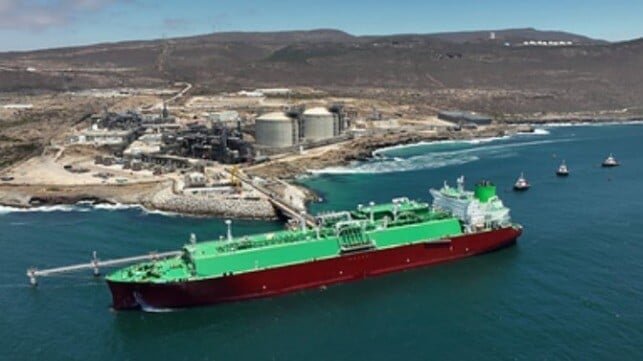
Sempra Infrastructure's Energia Costa Azul (ECA) LNG Phase 1 project on Mexico's Pacific Coast has shipped its inaugural liquefied natural gas (LNG) cargo, marking a pivotal moment for North American energy exports. This milestone establishes a new, more efficient trade route for U.S. natural gas to reach energy-hungry Asian markets, bypassing the Panama Canal.
The commencement of exports from ECA LNG Phase 1 significantly enhances North America's strategic position in global LNG supply, offering Asian buyers a crucial alternative to traditional Gulf Coast routes. Its operational launch provides critical logistical advantages, including reduced transit times and insulation from potential Panama Canal restrictions, thereby bolstering supply chain resilience and competitiveness in the Pacific Basin LNG market.
Executive Summary
The ECA LNG Phase 1 facility, a joint venture between Sempra Infrastructure and TotalEnergies, located in Ensenada, Baja California, has successfully loaded its first LNG cargo. This 3.25 million tonnes per annum (Mtpa) single-train liquefaction facility is Mexico's first West Coast LNG export site, designed to deliver U.S. natural gas, primarily from the Permian Basin, to Asian and Pacific Basin customers. The project, which received its Final Investment Decision (FID) in 2020 and saw construction from 2021 to 2025, is now ramping up towards full commercial operations, with long-term offtake agreements already in place with TotalEnergies and Mitsui.
What Happened
On July 8, 2026, Sempra Infrastructure announced the successful loading and shipment of the first LNG cargo from its ECA LNG Phase 1 project in Ensenada, Mexico. The vessel, Pacific Success, loaded for TotalEnergies, which will be the sole offtaker during the ramp-up phase. This follows a ramp-up in feed gas deliveries in June and the start of gas reception in May via the Rosarito pipeline, with substantial completion expected in summer 2026.
Key Developments
- Pacific Gateway Opens: ECA LNG Phase 1 is Mexico's first West Coast LNG export terminal, providing a direct route for U.S. natural gas to Asian markets.
- Capacity & Partners: The single-train facility boasts a nameplate capacity of 3.25 Mtpa and is jointly owned by Sempra Infrastructure (operator) and TotalEnergies (16.6%).
- Strategic Advantage: Its location bypasses the Panama Canal, offering shorter shipping routes and mitigating transit restrictions for Asian buyers, enhancing supply chain reliability.
- Offtake Secured: Long-term purchase agreements are established with TotalEnergies for 1.7 Mtpa and Japan's Mitsui for 0.8 Mtpa.
Regional Context
The ECA LNG project solidifies Mexico's emerging role as a key energy exporter and strengthens North America's overall LNG export capabilities. It provides a crucial Pacific outlet for U.S. natural gas, diversifying export options beyond the Gulf Coast.
Market Impact
For LNG traders and analysts, ECA LNG's operational start introduces new dynamics to Pacific Basin pricing and supply security, potentially easing reliance on longer routes. The shorter transit times could reduce shipping costs and improve delivery flexibility, impacting arbitrage opportunities and regional market balances. This new supply source from Mexico's West Coast offers a competitive edge, particularly for Northeast Asian buyers.
Outlook
Attention will now turn to the full commercial operation and ramp-up of ECA LNG Phase 1, as well as the progress of its planned larger second phase. The project's long-term success will also be a bellwether for future North American Pacific Coast LNG developments.